Which Countries Force a Woman to Carry a Baby Conceived by Rape?
Pregnancy is a potential result of rape. It has been studied in the context of war, particularly as a tool for genocide, as well equally other unrelated contexts, such as rape by a stranger, statutory rape, incest, and underage pregnancy. The current scientific consensus is that rape is at to the lowest degree equally likely to pb to pregnancy as consensual sexual intercourse, with some studies suggesting rape may actually result in higher rates of pregnancy than consensual intercourse.[ane] [ii] [3]
Rape tin can cause difficulties during and after pregnancy, with potential negative consequences for both the victim and a resulting child.[4] Medical treatment following a rape includes testing for, preventing, and managing pregnancy. A woman who becomes pregnant after a rape may face a conclusion about whether to raise the child or to brand an adoption plan. In some countries where abortion is illegal after rape and incest, over 90% of pregnancies in girls age 15 and under are due to rape past family members.[5]
The false conventionalities that pregnancy can about never consequence from rape was widespread for centuries. In Europe, from medieval times well into the 18th century a human could use a adult female's pregnancy as a legal defense to "prove" that he could non accept raped her. A woman's pregnancy was thought to mean that she had enjoyed the sex activity and, therefore, consented to it. In recent decades, some anti-abortion organizations and politicians (such equally Todd Akin) who oppose legal abortion in cases of rape have advanced claims that pregnancy very rarely arises from rape, and that the applied relevance of such exceptions to abortion constabulary is, therefore, limited or non-real.[6] [vii] [8]
Rape-pregnancy incidence [edit]
Estimates of the numbers of pregnancies from rape vary widely.[9] [x] Recent estimates advise that rape conception happens betwixt 25,000 and 32,000 times each year in the U.Due south. In a 1996 three-twelvemonth longitudinal study of 4,000 American women, physician Melisa Holmes estimated from data from her study that forced sexual intercourse causes over 32,000 pregnancies in the United states of america each twelvemonth.[11] Physician Felicia H. Stewart and economist James Trussell estimated that the 333,000 assaults and rapes reported in the United states of america in 1998 caused near 25,000 pregnancies, and up to 22,000 of those pregnancies could accept been prevented by prompt medical treatment, such every bit emergency contraception.[12] Other analyses bespeak a much lower charge per unit. The Rape, Corruption and Incest National Network, a charity based in Washington, D.C., reached a much lower figure calculated using estimates from the Justice Department'southward 2005 National Offense Victimization Survey. The network took that survey's annual average of 64,080 rapes committed in 2004 and 2005 and applies the 5 percent pregnancy rate to reach an judge of three,204 pregnancies a year from rape.[13]
Rate [edit]
A 1996 study of 44 cases of rape-related pregnancy estimated that in the United states, the pregnancy rate is 5.0% per rape among victims of reproductive age (aged 12 to 45).[11] [14] A 1987 written report also constitute a 5% pregnancy charge per unit from rape among xviii- to 24-year-former college students in the U.s..[15] A 2005 written report placed the rape-related pregnancy rate at around 3–5%.[sixteen]
A report of Ethiopian adolescents who reported being raped found that 17% subsequently became pregnant,[17] and rape crunch centres in Mexico reported the effigy the rate of pregnancy from rape at 15–18%.[18] Estimates of rape-related pregnancy rates may exist inaccurate since the crime is nether-reported, resulting in some pregnancies from rape non being recorded every bit such,[16] or alternately, social pressure may mean some rapes are not reported if no pregnancy results.
Most studies advise that formulation rates are independent of whether insemination is due to rape or consensual sexual practice.[19]
Some analysts have suggested that the rate of conception may exist higher from insemination due to rape.[20] [21] [22] [23] Psychologist Robert 50. Smith states that some studies have reported "unusually high rates of conception following rape".[20] He cites a paper by C.A. Fox and Beatrice Pull a fast one on, reporting that biologist Alan Sterling Parkes had speculated in personal correspondence that "at that place is a high conception rate in rape, where hormonal release, due to fear or anger, could produce reflex ovulation".[21] Smith likewise cites veterinary scientist Wolfgang Jöchle, who "proposed that rape may induce ovulation in human females".[22] [23] Literary scholar Jonathan Gottschall and economist Tiffani Gottschall argued in a 2003 Human being Nature article that previous studies of rape-pregnancy statistics were not direct comparable to pregnancy rates from consensual intercourse, because the comparisons were largely uncorrected for such factors as the use of contraception. Adjusting for these factors, they estimated that rapes are virtually twice as likely to issue in pregnancies (7.98%) equally "consensual, unprotected penile-vaginal intercourse" (2–four%). They discuss a variety of possible explanations and accelerate the hypothesis that rapists tend to target victims with biological "cues of high fecundity" or subtle indications of ovulation.[3]
In contrast, psychologists Tara Chavanne and Gordon Gallup Jr., found that women in the ovulatory phase of their menstrual bike reduce risk-taking behaviors, which could theoretically reduce the likelihood of rape during fertile periods.[24] Anthropologist Daniel Fessler disputed these findings, saying, "assay of conception rates reveals that the probability of formulation post-obit rape does not differ from that following consensual coitus".[nineteen]
Sociobiological theories of rape pregnancy [edit]
Sociobiologists and evolutionary psychologists have hypothesized that causing pregnancy by rape may exist a mating strategy in humans, as a fashion for males to ensure the survival of their genes by passing them on to future generations.[25] Randy Thornhill and Craig T. Palmer are key popularizers of this hypothesis. They assert that most rape victims are women of childbearing age and that many cultures treat rape as a criminal offence against the victim's married man. They land that rape victims endure less emotional distress when they are subjected to more violence, and that married women and women of childbearing age feel greater psychological distress after a rape than do girls, single women or mail service-menopausal women.[26] Rape-pregnancy rates are crucial in evaluating these theories, because a high or depression pregnancy rate from rape would determine whether such adaptations are favored or disfavored by natural pick.[3]
Statutory rape, incest and underage pregnancy [edit]
In 1995–96, the journal Family Planning Perspectives published a study by the Guttmacher Institute, a sexual health research and policy organization, on statutory rape (sexual intercourse with a small-scale) and resulting pregnancies. It drew on other research[27] [28] to conclude that "at least one-half of all babies built-in to minor women are fathered by adult men", and that "although relatively pocket-size proportions of 13–xiv-year-olds have had intercourse, those who become sexually active at an early age are especially likely to take experienced coercive sex activity: Seventy-four per centum of women who had intercourse before historic period xiv and lx% of those who had sex activity before age 15 written report having had a forced sexual experience". Because of difficulties in bringing such cases to trial, however, "data from the menses 1975–1978 ... indicate that, on average, merely 413 men were arrested annually for statutory rape in California, fifty-fifty though 50,000 pregnancies occurred among underage women in 1976 lonely".[29] In that state, it was plant that ii thirds of babies born to school-age mothers were fathered past adult men.[27]
Sexual corruption early in life can atomic number 82 immature women to feel a lack of control over their sexual lives, subtract their future likelihood of using contraceptives such as condoms, and increase their chances of becoming pregnant or acquiring sexually transmitted infections.[18] A 2007 paper past Kid Trends[30] examined studies from 2000 to 2006 to identify links between sexual abuse and teenage pregnancy, starting with Blinn-Thruway et al.'due south 2002 metastudy of xv studies since 1989.[31] Information technology found that childhood sexual abuse has a "significant association" with adolescent pregnancy. Directly connections take been demonstrated both by retrospective studies examining antecedents to reported pregnancies and prospective studies, which rails the lives of sex abuse victims and "can be helpful for determining causality".[30] : iii The more severe forms of abuse, such as rape and incest, entail a greater take chances of boyish pregnancy.[30] : four [32] [33] Although some researchers suggest that pregnancy could exist a choice fabricated to escape a "bad situation", it may also be "a directly result of unwanted intercourse", which one report found to be the case for near 13% of participants in a Texas parenting program.[thirty] : four [34]
In Nicaragua, between 2000 and 2010, effectually 172,500 births were recorded for girls under 14, representing around thirteen% of the x.3 1000000 births during that menstruation. These were attributed to poverty, laws forbidding ballgame for rape and incest, lack of admission to justice, and beliefs held in the culture and legal system.[5] [35] A 1992 report in Republic of peru constitute that 90% of babies delivered to mothers anile 12–16 were conceived through rape, typically past a begetter, stepfather, or other close relative.[5] [36] In 1991 in Costa Rica, the figure was like, with 95% of adolescent mothers under 15 having become meaning through rape.[5] [37]
Many of the youngest documented nascence mothers in history experienced precocious puberty and were impregnated as a upshot of rape, including incest. The youngest, Peruvian Lina Medina, was impregnated when she was iv and had a live birth in 1939, at age 5.[38]
Rape in war and conflict [edit]
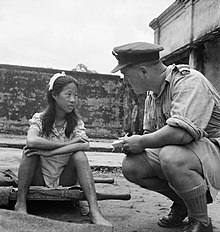
Rape has been used as a weapon of psychological warfare for centuries, to terrorize, humiliate, and undermine the morale of the enemy. Rape was likewise used as an act of ethnic cleansing to produce babies that share the perpetrators' ethnicity.[39] Forced pregnancy has been noted in places including Bangladesh, Darfur, and Bosnia.[twoscore] More broadly, pregnancy ordinarily results from wartime rape that was perpetrated without the intention of impregnating the enemy, as has been found in conflicts in E Timor, Liberia, Kosovo, and Rwanda.[xl] Gita Sahgal of Amnesty International commented that, rather than being primarily about "spoils of state of war" or sexual gratification, rape is often used in ethnic conflicts every bit a way for attackers to perpetuate social control and redraw ethnic boundaries.[41] Children may be built-in to women and girls forced to "marry" abductors and occupiers; this happened in the Indonesian occupation of Democratic republic of timor-leste and in the Lord's Resistance Army's disharmonize in Republic of uganda.[42]
Rape during war is recognized nether Un Security Quango Resolution 1820 as a war criminal offense and a crime against humanity.[43] "Forced pregnancy" is specifically enumerated as a state of war offense and law-breaking against humanity in the Rome Statute, which was the "first international criminal tribunal e'er officially to criminalize forced pregnancy".[44]
Children born as the result of wartime rape may be identified with the enemy and abound upwardly stigmatized and excluded by their communities; they may be denied bones rights or even killed earlier reaching adulthood.[40] Children are peculiarly at risk for such abuse when they are visibly identifiable as sharing half their ethnicity with the occupying forces, as in the example of half-Arab children of Darfuri women raped by janjaweed soldiers equally part of the war in Darfur.[45] Children of war rape are also at risk due to neglect by traumatized mothers unable to provide sufficient care.[45]
Rape of Nanking [edit]
In 1937 the Japanese army took over Nanking, which at the time was the majuscule of China. In the resulting 7-week occupation known every bit the Rape of Nanking, as many equally 80,000 women were raped.[46] Chinese women and girls of all ages were raped, mutilated, tortured, sexually enslaved, and killed; unknown numbers of them were left pregnant.[46] Many meaning Nanking women killed themselves in 1938, and others committed infanticide when their babies were born.[46] During the rest of the 20th century there was no record of any Chinese woman acknowledging her child as having been built-in as a result of the Rape of Nanking.[46]
Bosnian War [edit]
During the 1992–95 Bosnian War, pregnancy from rape was used to perpetrate genocide. There were reports of deliberately created "rape camps" intended to impregnate convict Muslim and Croatian women. Women were reported to have been kept in solitude until their pregnancies had advanced beyond a stage at which abortion would be condom.[47] In the context of a patrilineal society, in which children inherit their begetter's ethnicity, such camps were intended to create a new generation of Serbian children.[47] The women's group Tresnjevka claimed that more than 35,000 women and children were held in such Serb-run camps.[48] [49] [l] Estimates range from xx,000[51] to 50,000[52] victims.[53] [54] [55] Feryal Gharahi of Equality Now reported:[56]
- Families were separated, and women and children were kept in the gym, where all of the women and girls over ten years old were raped in the first few days.... There are rape camps all over the land. Thousands of women are being raped and killed. Thousands of women are significant as a result of rape. Over and again, everywhere I went in Bosnia-Herzegovina and in Croatian refugee camps, women told me stories of anathema – of being kept in a room, raped repeatedly and told they would exist held until they gave birth to Serbian children.
After the Bosnian State of war, the International Criminal Court updated its statute to prohibit "confin[ing] one or more women forcibly fabricated meaning, with the intent of affecting the ethnic composition of any population".[57]
Treatment and outcomes [edit]
Immediate post-rape protocols call for medical professionals to assess the likelihood that a victim will become meaning in their assessment of the concrete impairment done to the woman. Protocol for gaining a history of the employ of contraceptives, as a adult female'southward employ of birth control pills or other contraceptives before a rape affect her chance of condign pregnant.[58] Treatment protocols as well call for clinicians to provide access to emergency contraception and counseling on abortion in countries where it is legal.[59] High-dose estrogen pills were tried as an experimental treatment afterwards rape in the 1960s, and in 1972 Canadian physician A. Albert Yuzpe and his colleagues began systematic studies on the use of ethinylestradiol and norgestrel to provide emergency contraception after an attack. These treatments reduced the rate of pregnancy after rape past 84%.[threescore] This method is at present called the Yuzpe regimen.[61] Before existence treated with pregnancy prevention measures, a rape victim is given a HCG pregnancy examination to determine whether she was already pregnant before the rape.[62]
When being discharged from emergency care, clinicians provide information near pregnancy likewise as other complications such as infection and emotional trauma.[62] While a woman who has become pregnant during the past 48 hours will test negative for pregnancy in an HCG pregnancy test (unless she was already pregnant before the rape), pregnancy resulting from the rape tin exist detected at the two-week follow-up visit.[63]
Decisions of whether to end a rape-related pregnancy or carry it to term, and whether to keep the kid or identify the kid for adoption can be severely traumatizing for a woman.[64] Abortion rates for pregnancies due to rape vary significantly by civilization and demographics; women who alive in countries where abortion is illegal must often give birth to the kid or secretly undergo a unsafe, unsafe abortion.[xviii] Some women do non wish to get abortions for religious or cultural reasons.[65] In a third of cases, rape-related pregnancies are not discovered until the second trimester of pregnancy, which may reduce a adult female's options, specially if she doesn't have like shooting fish in a barrel access to legal abortion or is still recovering from the trauma of the rape itself.[66]
In the United States, 1 percentage of 1,900 women questioned in 1987 listed rape or incest as the reason for having an abortion; of these, 95 percent named other reasons as well.[67] A 1996 study of thousands of US women showed that, of pregnancies resulting from rape, fifty% were aborted, 12% resulted in miscarriage, and 38% were brought to term and either placed for adoption or raised.[14] Peer-reviewed studies accept reported from 38% of American women to 90% of Peruvian adolescents carrying the pregnancy to term.[11] [68] In Lima, Peru, where abortion is illegal, 90% of girls aged 12 to 16 who became pregnant through rape carried the child to term.[68] Of all children born, 1% are placed for adoption; the number of children conceived from rape who are placed for adoption was institute to be most 6% in one report and 26% in another.[69] When a mother commits neonaticide, killing an baby younger than 24 hours old, the child'due south nascence being the effect of rape is a main cause, although other psychological and situational factors are generally nowadays.[70] Some people turn to drugs or booze to cope with emotional trauma after a rape; utilize of these during pregnancy tin damage the fetus.[71]
Children of rape [edit]
When a mother chooses to raise her child conceived in rape, the traumatic effect of the rape and the child's blood relationship to the rapist has the potential to create some psychological challenges, but the circumstance of conception is no guarantee to cause psychological bug.[69] [72] If a woman decides to proceed and raise the child, she may accept difficulty accepting information technology, and both female parent and child confront ostracism in some societies.[73]
Mothers may also face legal difficulties. In most United states of america states, the rapist maintains parental rights.[74] Inquiry by legal scholar Shauna Prewitt indicates that the resulting continued contact with the rapist is damaging for women who go along the child.[74] She wrote in 2012 that in the Us, 31 states allow rapists to assert custody and visitation rights over children conceived through rape.[72]
History [edit]
Infanticide [edit]
Children whose births issue from rape have been killed by their mothers at various times in history. During ancient and medieval times, such infanticide was not prohibited (nevertheless, penance was expected of these mothers in medieval Europe).[66]
Beliefs about whether rape can result in pregnancy [edit]

The Ancient Greek physician Galen'southward belief that women could not excogitate without pleasure influenced medical and legal thinking for centuries.
Beliefs that rape could non lead to pregnancy were widespread in both legal and medical opinion for centuries.[75] [76] Galen, an ancient Greek dr., believed that a woman must feel pleasance to release "seed" and become pregnant, and could not derive such pleasure from nonconsensual sexual activity.[77] Galen'due south thinking influenced understanding from medieval England to Colonial America.[77]
The Aboriginal Greek philosopher Aristotle also believed that female pleasance played a central function in conception.[ citation needed ] Female reproduction was, in many ways, viewed through the lens of male reproductive processes, imagining that female organs functioned equally inverted versions of male organs, and hence orgasm was required for conception.[75]
Centuries later, in medieval Europe, the conventionalities that pregnancy could not occur without consent was nonetheless standard; in fact, conception past a adult female was considered a legitimate defence force against charges of rape.[76] The belief was codification in the medieval British law texts Fleta [75] and Britton. Britton states:[78]
If the defendant confesses the fact, but says that the woman at the same fourth dimension conceived by him, and can prove it, then our will is that it exist adjudged no felony, because no woman can conceive if she does non consent.
Medieval literary scholar Corinne Saunders acknowledged a difficulty in determining how widely held was the belief that pregnancy implies consent, merely concluded that it influenced "at least some justices", citing a 1313 example in Kent.[79]
Past the late 1700s, scientists no longer universally accustomed the view that pregnancy was impossible without pleasure, although this view was yet mutual.[80] A 1795 British legal text, Treatise of Pleas of the Crown, disparaged the conventionalities'south legal utility and its biological veracity:[76] [81]
Too it hath been said by some to be no rape to force a woman who conceives at the time; for it is said, that if she had not consented, she could not take conceived, simply this stance seems very questionable, not only because the previous violence is no way extenuated by such a subsequent consent, only also because, if it were necessary to shew that the woman did not excogitate, the offender could non be tried till such time as it might appear whether she did or did not, and as well because the philosophy of this notion may very well be doubted of.
The 1814 British legal text Elements of Medical Jurisprudence by Samuel Farr claimed that conception "probably" could not occur without a woman's "enjoyment", and so that an "accented rape" was unlikely to atomic number 82 to pregnancy.[75] [82] On the other hand, in the US in an 1820 court case in the Arkansas Territory a man pleaded not guilty to rape charges because the victim became pregnant, just the court rejected the argument:[83]
The old notion that if the woman conceive, it could not be a rape, because she must take in such example take consented, is quite exploded. Impregnation, information technology is well known, does non depend on the consciousness or volition of the female. If the uterine organs be in a condition favorable to impregnation, this may take place as readily as if the intercourse was voluntary.
In more recent times, opponents of legal abortion have argued that pregnancy resulting from rape is rare.[7] [2] In a 1972 article, physician and anti-abortion activist Fred Mecklenburg argued that pregnancy from rape is "extremely rare", adding that a woman exposed to the trauma of rape "will not ovulate even if she is 'scheduled' to".[84] Blythe Bernhard wrote in The Washington Post, "That article has influenced ii generations of anti-abortion activists with the hope to build a medical instance to ban all abortions without any exception."[85]
Islamic law [edit]
Historian Ian Talbot has written about how countries with Quran-based Islamic codes on rape and pregnancy use Sura An-Nur, verse ii, as a legal basis: "The law of show in all sexual crimes required either self-confession or the testimony of four upright (salah) Muslim males. In the case of a homo, cocky-confession involved a exact confession. For women yet medical examinations and pregnancy arising from rape were admissible every bit proof of self-guilt." Under Islamic Law a woman can impale her rapist. [86]
Male victims [edit]
Pregnancy from rape can also occur when the victim is male and the rapist is female. Many such cases involve the statutory rape of underage boys by developed women who subsequently became pregnant. In Kansas, Hermesmann v. Seyer established that a male person victim of rape can exist held liable to pay child support for a baby that results from the rape, and afterwards cases in the United states have held as well.[87] [88] [89]
See also [edit]
- Abortion-rights movements
- Effects and aftermath of rape
- Forced pregnancy
- Rape and pregnancy statement controversies in the 2012 United States elections
- Reproductive coercion
- Sociobiological theories of rape
- Unintended pregnancy
- War on Women
- Wartime sexual violence
References [edit]
- ^ Dellorto, Danielle (22 August 2012). "Experts: Rape does non lower odds of pregnancy". CNN Health.
- ^ a b Begley, Sharon; Heavey, Susan (twenty August 2012). "Rape trauma as bulwark to pregnancy has no scientific footing". Reuters. Archive version.
- ^ a b c Gottschall, Jonathan A.; Gottschall, Tiffani A. (2003). "Are per-incident rape-pregnancy rates college than per-incident consensual pregnancy rates?". Human Nature. xiv (1): ane–xx. doi:10.1007/s12110-003-1014-0. PMID 26189986. S2CID 20886610. Lay summary – Pol (21 August 2012).
- ^ Boyer, Debra; Fine, David (1992). "Sexual Abuse equally a Gene in Adolescent Pregnancy and Child Maltreatment". Family Planning Perspectives. 24 (1): 4–nineteen. doi:ten.2307/2135718. ISSN 0014-7354. JSTOR 2135718. PMID 1601126.
- ^ a b c d O'Toole, Laura L.; Schiffman, Jessica R., eds. (1997). Gender Violence: Interdisciplinary Perspectives. p. 235. ISBN978-0-8147-8041-i.
- ^ Brian Clowes, The Facts of Life: An Authoritative Guide to Life & Family unit Issues, Chapter 3: Exceptions for Abortion: The Frequency of Rape-Caused Pregnancies Archived 27 August 2012 at the Wayback Car (Human Life International, 1997). ISBN 978-1-55922-043-9.
- ^ a b "Health Experts Dismiss Assertions on Rape". The New York Times. 21 Baronial 2012. Retrieved 21 August 2012.
- ^ Garance Franke-Ruta, Analysis — A Canard That Will Non Die: 'Legitimate Rape' Doesn't Crusade Pregnancy, National Journal (21 August 2012).
- ^ Kim Geiger, Statistics on rape and pregnancy are complicated, Los Angeles Times, 23 August 2012. Retrieved 24 May 2014.
- ^ Sue Owen, Surveys testify broad disagreement on number of rape-related pregnancies per yr, Politifact, Austin American Statesman, 15 Baronial 2013. Retrieved 24 May 2014.
- ^ a b c Holmes, Melisa M.; Resnick, Heidi S.; Kilpatrick, Dean 1000.; Best, Connie L. (1996). "Rape-related pregnancy: Estimates and descriptive characteristics from a national sample of women". American Periodical of Obstetrics and Gynecology. 175 (2): 320–four, discussion 324–5. doi:ten.1016/S0002-9378(96)70141-2. PMID 8765248. (abstruse also available at NIH pubmed site Retrieved 24 May 2014.)
- ^ Stewart, Felicia H; Trussell, James (2000). "Prevention of pregnancy resulting from rape: A neglected preventive health measure". American Periodical of Preventive Medicine. 19 (4): 228–9. doi:x.1016/S0749-3797(00)00243-nine. PMID 11064225.
- ^ Sue Owen, Surveys show wide disagreement on number of rape-related pregnancies per twelvemonth, Politifact, Austin American Statesman, xv Baronial 2013. Retrieved 24 May 2014.
- ^ a b Thornhill, Randy; Palmer, Craig T. (2001). A Natural History of Rape: Biological Bases of Sexual Compulsion. MIT Press. p. 100. ISBN978-0-262-70083-2.
- ^ Koss, Mary P.; Gidycz, Christine A.; Wisniewski, Nadine (1987). "The scope of rape: Incidence and prevalence of sexual assailment and victimization in a national sample of higher education students". Journal of Consulting and Clinical Psychology. 55 (2): 162–70. doi:ten.1037/0022-006X.55.2.162. PMID 3494755.
- ^ a b Hazelwood and Burgess 2009, p. 28.
- ^ Mulugeta, Eastward; Kassaye, 1000; Berhane, Y (1998). "Prevalence and outcomes of sexual violence among high school students". Ethiopian Medical Journal. 36 (three): 167–74. PMID 10214457.
- ^ a b c Krug 2002, p. 162.
- ^ a b Fessler, Daniel M.T. (2003). "Rape is non less frequent during the ovulatory stage of the menstrual bicycle". Psychology, Evolution & Gender. five (three): 127–47. doi:x.1080/14616660410001662361.
- ^ a b Smith, Robert 50. (2005). "Man sperm competition". In Shackelford, Todd One thousand.; Pound, Nicholas (eds.). Sperm Competition in Humans: Classic and Contemporary Readings. Taylor & Francis. ISBN978-0-387-28036-3. [ page needed ]
- ^ a b Fox, C. A.; Fox, B. (1971). "A Comparative Study of Coital Physiology, with Special Reference to the Sexual Climax". Reproduction. 24 (three): 319–36. doi:x.1530/jrf.0.0240319. PMID 4926898.
- ^ a b Jöchle, Wolfgang (1973). "Coitus-induced ovulation". Contraception. 7 (6): 523–64. doi:x.1016/0010-7824(73)90023-1.
- ^ a b Jöchle, West (1975). "Current inquiry in coitus-induced ovulation: A review". Journal of Reproduction and Fertility. Supplement (22): 165–207. PMID 810583.
- ^ Chavanne, Tara J; Gallup, Gordon G (1998). "Variation in Risk Taking Behavior Amidst Female Higher Students as a Function of the Menstrual Cycle". Evolution and Human Behavior. 19: 27–32. doi:x.1016/S1090-5138(98)00016-6.
- ^ McKibbin, William F.; Shackelford, Todd K.; Goetz, Aaron T.; Starratt, Valerie Grand. (2008). "Why do men rape? An evolutionary psychological perspective". Review of General Psychology. 12: 86–97. doi:ten.1037/1089-2680.12.1.86. S2CID 804014.
- ^ Thornhill, Randy; Palmer, Craig T (2000). "Why men rape". The Sciences. 40 (1): xxx–6. doi:10.1002/j.2326-1951.2000.tb03465.ten. ISSN 0036-861X. OCLC 93004665.
- ^ a b Landry, David J.; Forrest, Jacqueline Darroch (1995). "How Old Are U.S. Fathers?". Family Planning Perspectives. 27 (4): 159–61, 165. doi:10.2307/2136260. JSTOR 2136260. PMID 7589357.
- ^ Males, Mike; Chew, Kenneth S Y (1996). "The ages of fathers in California adolescent births, 1993". American Journal of Public Wellness. 86 (4): 565–viii. doi:10.2105/AJPH.86.four.565. PMC1380562. PMID 8604792.
- ^ Michael M. 5. Sonoma County Superior Court, 450 U.S. 464 (1981).
- ^ a b c d Babyhood sexual abuse and teen pregnancy: a white paper Archived 21 October 2012 at the Wayback Machine – Logan et al., 2007
- ^ Blinn-Pike, Lynn; Berger, Thomas; Kuschel, Diane; Kaplan, Michael; Kaplan, M (2002). "Is At that place a Causal Link between Maltreatment and Adolescent Pregnancy? A Literature Review". Perspectives on Sexual and Reproductive Health. 34 (2): 68–75. doi:ten.2307/3030209. JSTOR 3030209. PMID 12043711.
- ^ Kenney, Janet West.; Reinholtz, Cindy; Angelini, Patti Jo (1997). "Ethnic differences in childhood and boyish sexual abuse and teenage pregnancy". Journal of Adolescent Wellness. 21 (1): three–10. doi:10.1016/S1054-139X(97)00035-9. PMID 9215504.
- ^ Saewyc, Elizabeth M.; Magee, Lara Leanne; Pettingell, Sandra E. (2004). "Teenage Pregnancy and Associated Chance Behaviors Amidst Sexually Abused Adolescents". Perspectives on Sexual and Reproductive Wellness. 36 (3): 98–105. doi:10.1363/3609804. PMID 15306268.
- ^ Kellogg, ND; Hoffman, TJ; Taylor, ER (1999). "Early on sexual experiences amongst significant and parenting adolescents". Boyhood. 34 (134): 293–303. PMID 10494978.
- ^ Silva, José Adán (22 August 2012). "Meaning Nicaraguan Girls Forced to Go Mothers". IPS. Retrieved 21 October 2012.
- ^ Rosas 1992[ verification needed ]
- ^ Treguear & Carro, 1991[ verification needed ]
- ^ Dark-brown, Elgar (11 July 1939). "American scientists await U.Southward. visit of youngest female parent: Peruvian girl and babe will be exhibited". San Antonio Calorie-free. p. 2A.
- ^ Carpenter 2007, pp. i–ii.
- ^ a b c Carpenter 2007, p. 2.
- ^ Smith-Spark, Laura (eight December 2004). "In Depth | How did rape become a weapon of war?". BBC News . Retrieved 4 March 2010.
- ^ Carpenter 2007, p. 5, 94–95.
- ^ "Geneva Conventions every bit Discussed in Rape Law-breaking". Encyclopædia Britannica . Retrieved vii September 2012.
- ^ 2012 police-review paper.
- ^ a b Carpenter 2007, p. 5.
- ^ a b c d Smith 2004, p. 194–5.
- ^ a b Hazelwood and Burgess 2009, p. 34.
- ^ de Brouwer 2005, pp. nine–x.
- ^ Angela Robson (June 1993). "Rape: Weapon of State of war". New Internationalist. No. 244. Archived from the original on 17 August 2010.
- ^ "Bosnia: Landmark Verdicts for Rape, Torture, and Sexual Enslavement". Human being Rights Sentry. 22 February 2001.
- ^ "short time line of Yugoslav war with number of rapes" (PDF). Massachusetts Institute of Engineering. Archived from the original (PDF) on 26 June 2008.
- ^ Zimonjic, Vesna Peric (20 February 2006). "Film award forces Serbs to confront spectre of Bosnia'southward rape babies". The Independent. London. Archived from the original on 17 April 2009. Retrieved 23 September 2014.
- ^ Aldi, Halilovic (21 Dec 2000). "Odjek – revija za umjetnost i nauku – Zločin silovanja u BiH". Odjek.ba. Archived from the original on 25 November 2011. Retrieved 7 September 2012.
- ^ "Grbavica (film)". Coop99.at. Retrieved 7 September 2012.
- ^ "ICTY: Krnojelac verdict". United Nations. five March 2007. Retrieved seven September 2012.
- ^ Gharahi, Feryal (1 February 1993). "Bosnia-Herzegovina: Mass Rape, Forced Pregnancy, Genocide". Equality At present. Archived from the original on 16 February 2016. Retrieved 31 August 2012.
- ^ de Brouwer 2005, p. 145.
- ^ Krug 2002, pp. 162, 166.
- ^ Krug 2002, p. 166.
- ^ Yuzpe, AA; Smith, RP; Rademaker, AW (1982). "A multicenter clinical investigation employing ethinyl estradiol combined with dl-norgestrel as postcoital contraceptive amanuensis". Fertility and Sterility. 37 (4): 508–13. doi:ten.1016/S0015-0282(16)46157-i. PMID 7040117.
- ^ Haspels, AA (1994). "Emergency contraception: A review". Contraception. fifty (ii): 101–8. doi:10.1016/0010-7824(94)90046-9. PMID 7956209.
- ^ a b Jenkins and Braen 2004, p. 311.
- ^ Jenkins and Braen 2004, pp. 311–312.
- ^ de Brouwer 2005, p. 225.
- ^ Price 2007, p. 173.
- ^ a b Solomon, Andrew (29 Baronial 2012). "The Legitimate Children of Rape". The New Yorker . Retrieved 19 Feb 2013.
- ^ Tamar Lewin, https://world wide web.nytimes.com/1989/10/13/u.s./rape-and-incest-just-ane-of-all-abortions.html Rape and Incest: Simply 1% of All Abortions', New York Times, thirteen October 1989. Retrieved 24 May 2015
- ^ a b Tobach, Ethel; Reed, Rachel (2003). "Understanding rape". In Travis, Cheryl Dark-brown (ed.). Evolution, Gender, and Rape. MIT Printing. ISBN978-0-262-70090-0. [ page needed ]
- ^ a b Palmer, Brian (22 August 2012). "Should a Mother Tell Her Child He Was Conceived in a Rape?". Slate . Retrieved 29 Baronial 2012.
- ^ Eric West. Hickey (22 July 2003). "Child killing". Encyclopedia of Murder and Violent Criminal offence. SAGE. pp. 78–80. ISBN978-0-7619-2437-1 . Retrieved xiv February 2013.
- ^ Price 2007, p. 151–152.
- ^ a b Prewitt, Shauna (22 Baronial 2012). Raped, significant and ordeal not over. CNN
- ^ de Brouwer 2005, p. 144.
- ^ a b Prewitt, Shauna R. (2010). "Giving Birth to a 'Rapist's Kid': A Give-and-take and Analysis of the Limited Legal Protections Afforded to Women Who Become Mothers Through Rape". Georgetown Law Journal. 98 (3): 831–62. Archived from the original on 24 October 2012.
- ^ a b c d Vanessa Heggie Archived 30 July 2012 at the Wayback Machine, 'Legitimate rape' – a medieval medical concept, The H Word, hosted by The Guardian (twenty August 2012).
- ^ a b c Tucker, Jennifer. The Medieval Roots of Todd Akin's Theories, The New York Times (23 Baronial 2012).
- ^ a b Smith 2004, p. 155.
- ^ Francis Morgan Nichols (1865). Britton; the French Text Advisedly Revised with an English Translation, Introduction and Notes. Clarendon Press. p. 114. ISBN9780598380487 . Retrieved eighteen February 2013.
- ^ Saunders, Corinne J. (2001). Rape and Ravishment in the Literature of Medieval England. D. S. Brewer, ISBN 978-0-85991-610-3
- ^ Smith 2004, p. 2–3.
- ^ William Hawkins, Treatise of Pleas of the Crown, seventh edition, p. 308 (London, 1795).
- ^ Samuel Farr, Elements of Medical Jurisprudence, second edition, chapter 4 (London, 1814). See too scanned original book.
- ^ Hempstead, Samuel H; Circuit Courtroom (9Th Excursion), U.s.; Superior Court, Arkansas; District Court (Arkansas), United States (1856). U.S. 5. Dickinson, one Hempstead Reporter 1 (1820 Ark. Territory), at two due north.ane.
- ^ Mecklenburg, Fred East. (1972). The Indications for Induced Abortion: A Physician'southward Perspective. In Abortion and Social Justice, Thomas Hilgers and Dennis Horan, eds., p. 50. Sheed & Ward, ISBN 978-0-8362-0542-viii
- ^ Bernhard, Blythe (22 August 2012). The roots of Rep. Todd Akin'south "legitimate" rape remarks. The Washington Mail
- ^ Talbot Ian (1998). Islamic republic of pakistan: A Modern History. Palgrave Macmillan. p. 276. ISBN 978-0-312-21606-1
- ^ "Court Tells Youth to Support Child He Fathered at Historic period 13". New York Times. 6 March 1993. Retrieved vii June 2021.
- ^ "Arizona Is Requiring A Male Statutory Rape Victim To Pay Child Support". Business Insider. 2 September 2014. Retrieved 7 June 2021.
- ^ "Statutory Rape Victim Ordered To Pay Child Support". Chicago Tribune. 22 December 1996. Retrieved 7 June 2021.
Bibliography [edit]
- Carpenter, R. Charli (25 June 2007). Born of War: Protecting Children of Sexual Violence Survivors in Disharmonize Zones. Kumarian Press. ISBN978-ane-56549-237-0 . Retrieved 15 February 2013.
- de Brouwer, Anne-Marie (2005). Supranational Criminal Prosecution of Sexual Violence: The ICC and the Practice of the ICTY and the ICTR. Intersentia nv. ISBN978-90-5095-533-1 . Retrieved 31 January 2013.
- Hazelwood, Robert R.; Burgess, Ann Wolbert (2009). Practical Aspects of Rape Investigation: A Multidisciplinary Approach. CRC Printing. ISBN978-1-4200-6504-6 . Retrieved 29 January 2013.
- Jenkins, Jon L.; Braen, G. Richard (one Baronial 2004). Transmission of Emergency Medicine, 5e. Lippincott Williams & Wilkins. ISBN978-0-7817-5035-6 . Retrieved 15 February 2013.
- Krug, Etienne One thousand.; World Health Organization (2002). Globe Report on Violence and Wellness. World Wellness Arrangement. ISBN978-92-4-154561-7 . Retrieved xv February 2013.
- Price, Sally (2007). Mental Health in Pregnancy and Childbirth. Elsevier Wellness Sciences. ISBN978-0-443-10317-9 . Retrieved xv February 2013.
- Smith, Merril D. (2004). Encyclopedia of Rape. Greenwood Publishing Group. ISBN978-0-313-32687-5 . Retrieved 29 January 2013.
Further reading [edit]
- Beebe, DK (1991). "Emergency management of the adult female rape victim". American Family Dr.. 43 (6): 2041–6. PMID 2042547.
- Campbell, R; Bybee, D (1997). "Emergency medical services for rape victims: Detecting the cracks in service delivery". Women's Health. iii (two): 75–101. PMID 9332152.
- Krueger, Mary Yard. (1988). "Pregnancy as a result of rape". Journal of Sex Education & Therapy. xiv (1): 23–7. doi:10.1080/01614576.1988.11074920.
- Lathrop, Anthony (1998). "Pregnancy Resulting from Rape". Journal of Obstetric, Gynecologic, & Neonatal Nursing. 27 (1): 25–31. doi:10.1111/j.1552-6909.1998.tb02587.x. PMID 9475124.
- McFarlane, J. (2007). "Pregnancy Following Partner Rape: What We Know and What We Need to Know". Trauma, Violence, & Corruption. viii (two): 127–34. doi:10.1177/1524838007301222. PMID 17545570. S2CID 732231.
- Sutherland, Sandra; Scherl, Donald J. (2010). "Patterns of Response Among Victims of Rape". American Journal of Orthopsychiatry. twoscore (3): 503–11. doi:x.1111/j.1939-0025.1970.tb00708.x. PMID 5422298.
Source: https://en.wikipedia.org/wiki/Pregnancy_from_rape
0 Response to "Which Countries Force a Woman to Carry a Baby Conceived by Rape?"
Post a Comment