what could have been done to prrevent the collapse of the roman republic into autocracy?
/https://tf-cmsv2-smithsonianmag-media.s3.amazonaws.com/filer/77/ca/77ca0d02-21f2-434e-a6c4-2fd3825a2ac3/jhax0r.jpg)
Long before Julius Caesar declared himself dictator for life in 44 B.C., substantially spelling the beginning of the end to the Roman Republic, trouble was brewing in the halls of power.
The warning signs were there. Politicians such as Tiberius Gracchus and Gaius Gracchus (together known as the Gracchi brothers) were thwarted from instituting a series of populist reforms in the 100s B.C., and so murdered by their fellow senators. Old and unwritten codes of conduct, known equally the mos maiorum, gave mode as senators struggled for power. A general known as Sulla marched his regular army on Rome in 87 B.C., starting a civil state of war to prevent his political opponent from remaining in power. Yet none of these events take go as indelibly seared into Western retentiveness every bit Caesar's rise to ability or sudden downfall, his murder in 44 B.C.
"For whatever reason, nobody ever stops and says, if it was this bad by the 40s BC, what was it that started to go wrong for the Commonwealth?" says Mike Duncan, author and podcast host of The History of Rome and Revolutions. "Most people have been jumping into the story of the Late Republic in the third act, without any real comprehension of what started to go incorrect for the Romans in the 130s and 120s BC."
This was the question Duncan wanted to examine in his new book, The Storm Earlier the Storm: The Beginning of the Finish of the Roman Commonwealth. To larn more about the events that preceded the fall of the Republic, and what lessons the modern globe tin can learn from it, Smithsonian.com spoke with Duncan.
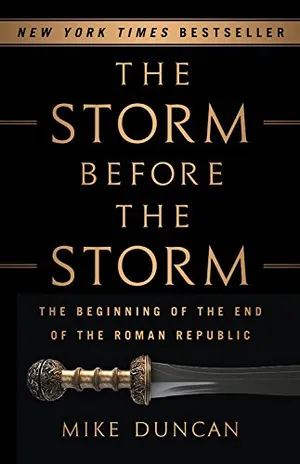
The Storm Before the Storm: The Beginning of the Stop of the Roman Republic
Chronicling the years 146-78 BC, Duncan dives into the lives of Roman politicians like Marius, Sulla, and the Gracchi brothers, who set dangerous new precedents that would start the Republic on the road to destruction and provide a stark warning about what can happen to a civilization that has lost its fashion.
What inspired you to look into this story?
When I was doing the History of Rome [podcast], and so many people asked me, 'Is the U.s.a. Rome? Are we following a like trajectory?' If you outset to do some comparisons between the rise and development of the U.S. and rise and development of Rome, yous do wind up in this same place. The United States emerging from the Common cold War has some analogous parts to where Rome was later on they defeated Carthage [in 146 B.C.]. This period was a wide-open field to fill a gap in our cognition.
1 topic you describe at length is economic inequality between citizens of Rome. How did that come well-nigh?
After Rome conquers Carthage, and after they decide to annex Greece, and after they conquer Spain and acquire all the silver mines, you have wealth on an unprecedented scale coming into Rome. The flood of wealth was making the richest of the rich Romans wealthier than would've been imaginable even a couple generations before. You're talking literally 300,000 gold pieces coming back with the Legions. All of this is being full-bodied in the hands of the senatorial elite, they're the consuls and the generals, then they think information technology's natural that it all accumulates in their hands.
At the aforementioned time, these wars of conquest were making the poor quite a bit poorer. Roman citizens were being hauled off to Spain or Greece, leaving for tours that would go on for three to five years a stretch. While they were gone, their farms in Italy would fall into disrepair. The rich started buying up big plots of land. In the 130s and 140s you have this process of dispossession, where the poorer Romans are beingness bought out and are no longer small citizen owners. They're going to be tenant owners or sharecroppers and it has a really corrosive effect on the traditional ways of economic life and political life. Every bit a upshot, you see this skyrocketing economical inequality.
Do you run across parallels betwixt land buying in Rome and in the modern United States?
In the Roman experience, this is the beginning of a 100-twelvemonth-long procedure of Italy going from existence a patchwork of smaller farms with some large estates to nothing only sprawling, commercially-oriented estates. And yes, the U.s.a. is continuing to go through a very similar process. At the founding of our republic, everybody's a farmer, and at present everything is endemic by what, Monsanto?
Moving across just strictly agricultural companies, big American corporations are now employing more and more people. There seems to be this move away from people owning and operating their ain establishments, and they're instead existence consumed past big entities. You're talking virtually the Amazons of the world swallowing upwards so much of the market share, information technology just doesn't pay to be a clerk in a bookstore or own a bookstore, you end up being a guy working in a warehouse, and information technology's not as skilful of a job.
Could the Roman senators accept done annihilation to forestall state being consolidated in the hands of the few?
It doesn't actually feel similar they could've arrested the procedure. Xv years afterwards some land bill, you'd ask, "Who has the land? The poor?" No, they all but got bought up again. There never was a good political solution to it. The trouble of these small citizen farmers was not solved until 100 years later when they just ceased to be.
If the Senate couldn't solve that one problem, could they accept prevented the finish of the Republic?
There were things that could have been washed to arrest the political collapse. People felt like the land was no longer working for them, that the Assemblies and Senate weren't passing laws for the benefit of anyone simply a modest group of elites. This resentment was threatening the legitimacy of the Republic in the optics of many citizens.
Even if they couldn't necessarily stop the acquisition of these huge backdrop or estates, there were other reforms they could've made to transition people from ane version of economical reality to some other: providing free grain for the cities, providing jobs building roads, trying to find places for these people to practice economically meaningful work that's going to permit them to make enough to support their families.
Then why didn't they accept action and make those reforms?
The Gracchi wanted to reform the Republican organization, only they also wanted to use those issues—economic inequality, grain for the plebs—to acquire political power for themselves. [Rival senators] believed this was going be terrible. If the Gracchi had been able to pass all of these popular pieces of legislation, they would have had more influence, and that was something their political rivals could non bide by. Information technology created a desire to defeat the Gracchi above all. Old rules of conduct didn't matter, unspoken norms weren't equally important as simply stopping the Gracchi from getting a win.
When Tiberius Gracchus introduced the Lex Agraria [to redistribute land back to poorer citizens], the Senate hired a tribune to veto it. This had never happened earlier. A tribune was supposed to be a defender of the people, and this was a popular neb. If it came to a vote, information technology was going to pass. It was non illegal what he was doing, only it was completely unprecedented, and this led Tiberius Gracchus to respond with his own measures, maxim, "I'1000 going to put my seal on the state treasury so no business tin exist transacted." [Tiberius was later murdered by the senators.] The issues themselves almost ceased to be as important as making sure your political rival didn't go a victory.
This is really what bedridden the Senate. It's 100 years of focusing on internal power dynamics instead of enlightened reform that caused the whole Republic to collapse.
When did this in-fighting outset to threaten the republic?
Information technology starts to fail after the imperial triumphs [over rival nations]. With Rome existence the most powerful nation in the Mediterranean world, and senatorial families controlling unimaginable wealth, there wasn't any kind of foreign check on their behavior. There was no threat making the Senate collectively say, "We need to stay together and can't let our internal fights go out of hand because that volition leave usa weak in the face of our enemies." They didn't have that existential fear anymore.
The other big thing is, with a new mode of pop politics, you kickoff having style more confrontations. Roman politics until about 146 B.C. was built upon consensus. By the period of my book, it becomes a politics of conflict. People start ignoring the erstwhile unspoken means of doing business organisation and the whole thing rolled down loma till it was warlords crashing into each other.
Another big issue was citizenship. How did the Romans determine who could be Romans?
When Rome conquered Italian republic in the 300s B.C., they would not addendum that city into the Roman state and brand the citizens Roman citizens or even subjects. A peace treaty would be signed, and that urban center would go an marry of Rome. Italy was a confederation, a protectorate nether Roman auspices. You couldn't even call them 2nd-class citizens because they were non citizens at all, they were merely allies. For a couple hundred years this was a pretty expert bargain, they didn't take to pay much in taxes and were allowed to govern themselves. After Rome hits this imperial triumph stage, they started looking at Roman citizenship as something they fervently desired. The Italians are facing the same stresses of economic inequality simply they don't even have a vote, they can't run for office, they have no political vocalisation at all, so they start to agitate for citizenship.
For about fifty years the Romans steadfastly turn down to allow this happen. The Senate and the lower-class plebs, it was one of the few things that united them. They might be pissed at each other, only they would join together against Italians.
Finally, in the belatedly 90s B.C., in that location was one last push [for Italians to be citizens] and the guy who put it forrard wound up getting murdered. The Italians erupted in insurrection. Most insurrections are people trying to break away from some ability—the Confederacy tries to pause away from the United states of america, the American colonies try to break abroad from the British—and the weird matter about the Social War is the Italians are trying to fight their way into the Roman system.
The ultimate consequences of allowing the Italians to become total roman citizens was nothing. There were no consequences. Rome just became Italy and everybody thrived, and they only did it later on this hugely destructive civil state of war that almost destroyed the commonwealth correct then and at that place.
Are there any lessons the United States can accept from Rome?
Rome winds upwardly existing for 1000 years as a civilisation. When the republic falls you're at nigh the halfway indicate. Ane of the reasons the Romans were so successful and why their empire did continue to grow was considering of how well they managed to integrate new groups. The Romans were ever successful when they integrated a new grouping, and always facing devastation and ruin when they tried to resist bringing new people in. The Social War [against the Italians] is a great early case. If you have a group of people that are going to be part of your civilization and act as soldiers in your army, you lot need to invite them into full participation in the organization. If you try to resist, all that you lot're going to practice is brand them mad at you.
The other biggie is if people's manner of life is being disrupted, and things are condign worse for them at the aforementioned time that this tiny clique of elites are making out like bandits, that creates a lot of resentful free energy. If you ignore genuine reformers, you exit the field open for cynical demagogues. They're going to use that resentful energy non to answer people's problems, merely for their ain personal advantage. They brand themselves powerful by exploiting people'due south fears, their grief, their anger. They say, "I know who to blame for all your problems, it'southward my personal enemies!"
What practice you hope readers come away from the book with?
I jokingly said when I started writing, that I wanted people to come out of it with a general feeling of unease about what's going on in the United States and in the West generally. To emerge from reading the volume, go back to flipping on the news, and think, "This is not good." Whatever your political persuasion, I think we tin can all concord that politics in the The states is becoming fairly toxic and if we're non careful we can current of air up going the way of the Roman Republic. In history, we oft go from shouting at each other to shooting each other—or in the olden days stabbing each other with swords.
I hope they read it every bit an example of a fourth dimension in history when people didn't pay attention to a lot of alert signs. If you ignore it, you lot run a risk the whole affair collapsing into civil war and a military dictatorship. I would like to avoid this. If people say, "Perhaps this is starting to await like the beginning of the end," and then maybe we can exercise some things to avoid the fate of the Roman Republic.
Source: https://www.smithsonianmag.com/history/fall-roman-republic-income-inequality-and-xenophobia-threatened-its-foundations-180967249/
0 Response to "what could have been done to prrevent the collapse of the roman republic into autocracy?"
Post a Comment